> ## Documentation Index
> Fetch the complete documentation index at: https://nova.laravel.com/docs/llms.txt
> Use this file to discover all available pages before exploring further.
# Installation
> Learn how to install Laravel Nova into your Laravel application.
Purchase a license for Laravel Nova
Watch the free Nova series on Laracasts
## Requirements
Laravel Nova has a few minimum requirements you should be aware of before installing:
* Composer 2
* Laravel Framework 10.x, 11.x, or 12.x
* Inertia.js 2.x
* Laravel Mix 6.x
* Node.js (Version 18.x+)
* NPM 9.x
## Browser Support
Nova supports modern versions of the following browsers:
* Apple Safari
* Google Chrome
* Microsoft Edge
* Mozilla Firefox
## Installing Nova via Composer
You may install Nova as a Composer package via our private Satis repository. To get started, add the Nova repository to your application's `composer.json` file:
```json composer.json theme={null}
"repositories": [
{
"type": "composer",
"url": "https://nova.laravel.com"
}
],
```
Or, you may use the following CLI command to add the Composer repository to your `composer.json` file:
```shell theme={null}
composer config repositories.nova '{"type": "composer", "url": "https://nova.laravel.com"}' --file composer.json
```
Next, you may add `laravel/nova` to your list of required packages in your `composer.json` file:
```json composer.json {4} theme={null}
"require": {
"php": "^8.2",
"laravel/framework": "^12.0",
"laravel/nova": "^5.0"
},
```
After your `composer.json` file has been updated, run the `composer update` command in your console terminal:
```shell theme={null}
composer update --prefer-dist
```
When running `composer update`, you will be prompted to provide a username and password. You should use your Nova website email for the username and a [license key](https://nova.laravel.com/licenses) should be used as the password. These credentials will authenticate your Composer session as having permission to download the Nova source code.
To avoid manually typing these credentials, you may create a [Composer auth.json file](https://getcomposer.org/doc/articles/http-basic-authentication) while using your [license key](https://nova.laravel.com/licenses) in place of your password:
```shell theme={null}
composer config http-basic.nova.laravel.com your-nova-account-email@your-domain.com your-license-key
```
Finally, run the `nova:install` and `migrate` Artisan commands. The `nova:install` command will install Nova's service provider and public assets within your application:
```shell theme={null}
php artisan nova:install
php artisan migrate
```
The default `App\Nova\User` Nova resource references the `App\Models\User` model. If you place your models in a different directory or namespace, you should adjust this value within the resource:
```php app/Nova/User.php {10} theme={null}
namespace App\Nova;
class User extends Resource
{
/**
* The model the resource corresponds to.
*
* @var class-string<\App\Models\User>
*/
public static $model = \App\Models\User::class;
}
```
If your application's `users` table is empty or you want to create a new user, you can run the `nova:user` Artisan command:
```shell theme={null}
php artisan nova:user
```
That's it! Next, you may navigate to your application's `/nova` path in your browser and you should be greeted with the Nova dashboard which includes links to various parts of this documentation.
## Registering a Nova License Key and Production URL
Nova requires a license key and a production URL to be used in production environments. Nova will check your license key and the current host against the values from the license details found in your Nova account.
You can generate license keys and register the production URL for your project inside the license's page on your Nova account at [https://nova.laravel.com/licenses](https://nova.laravel.com/licenses):
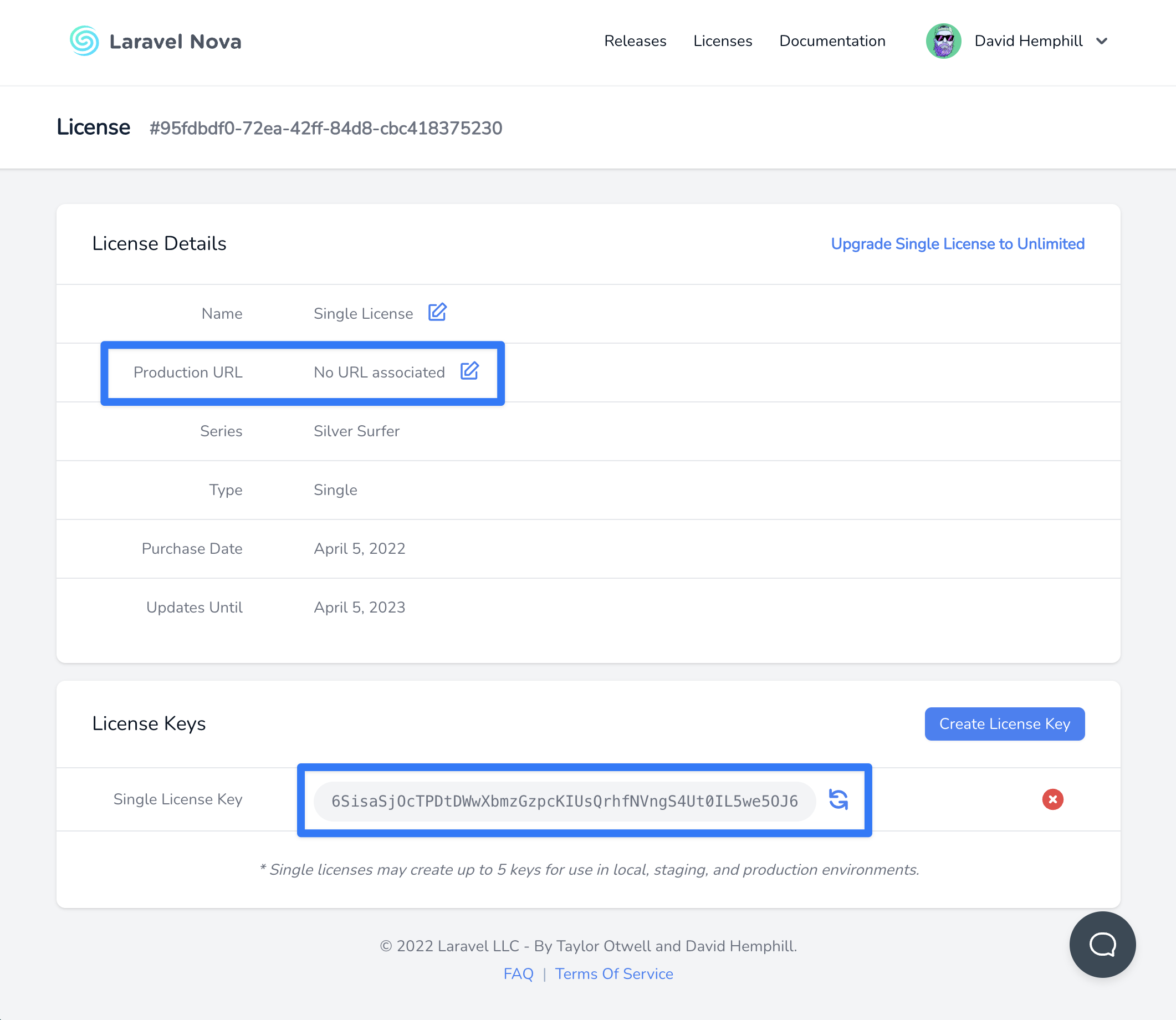 You can register a wildcard subdomain for your production URL for use in multi-tenant scenarios (e.g. `*.laravel.com`).
You can register your license key by setting the `NOVA_LICENSE_KEY` variable to `.env` file or `license_key` option in your `config/nova.php` configuration file:
```ini .env theme={null}
NOVA_LICENSE_KEY=
```
```php config/nova.php theme={null}
'license_key' => env('NOVA_LICENSE_KEY', ''),
```
### Verifying Your Nova License Key Configuration
To verify everything has been configured correctly, you should run the `nova:check-license` command:
```shell theme={null}
php artisan nova:check-license
```
## Authenticating Nova in CI Environments
It's not recommended to store your Composer `auth.json` file inside your project's source control repository. However, there may be times you wish to download Nova inside a CI environment like [GitHub Actions](https://github.com/features/actions). For instance, you may wish to run tests for any custom tools you create.
To authenticate Nova in these situations, you can use Composer's `config` command to set the configuration option inside your CI system's pipeline, injecting environment variables containing your Nova username and license key:
```shell GitHub Actions theme={null}
composer config http-basic.nova.laravel.com "${secrets.NOVA_USERNAME}" "${secrets.NOVA_LICENSE_KEY}"
```
## Using Nova on Development and Staging Domains
Since Nova can be used in local and staging development environments, Nova will not check your license key when used on `localhost` or local TLDs like those specified in [IETF RFC 2606](https://datatracker.ietf.org/doc/html/rfc2606#page-2):
* `.test`
* `.example`
* `.invalid`
* `.localhost`
* `.local`
Nova will also not check the current license key when the subdomain is one of these commonly-used staging subdomains:
* `staging.`
* `stage.`
* `test.`
* `testing.`
* `dev.`
* `development.`
## Authorizing Access to Nova
Within your `app/Providers/NovaServiceProvider.php` file, there is a `gate` method. This authorization gate controls access to Nova in **non-local** environments. By default, any user can access the Nova dashboard when the current application environment is `local`. You are free to modify this gate as needed to restrict access to your Nova installation:
```php app/Providers/NovaServiceProvider.php theme={null}
use Illuminate\Support\Facades\Gate;
// ...
/**
* Register the Nova gate.
*
* This gate determines who can access Nova in non-local environments.
*/
protected function gate(): void
{
Gate::define('viewNova', function ($user) {
return in_array($user->email, [
'taylor@laravel.com',
]);
});
}
```
## Customization
### Branding
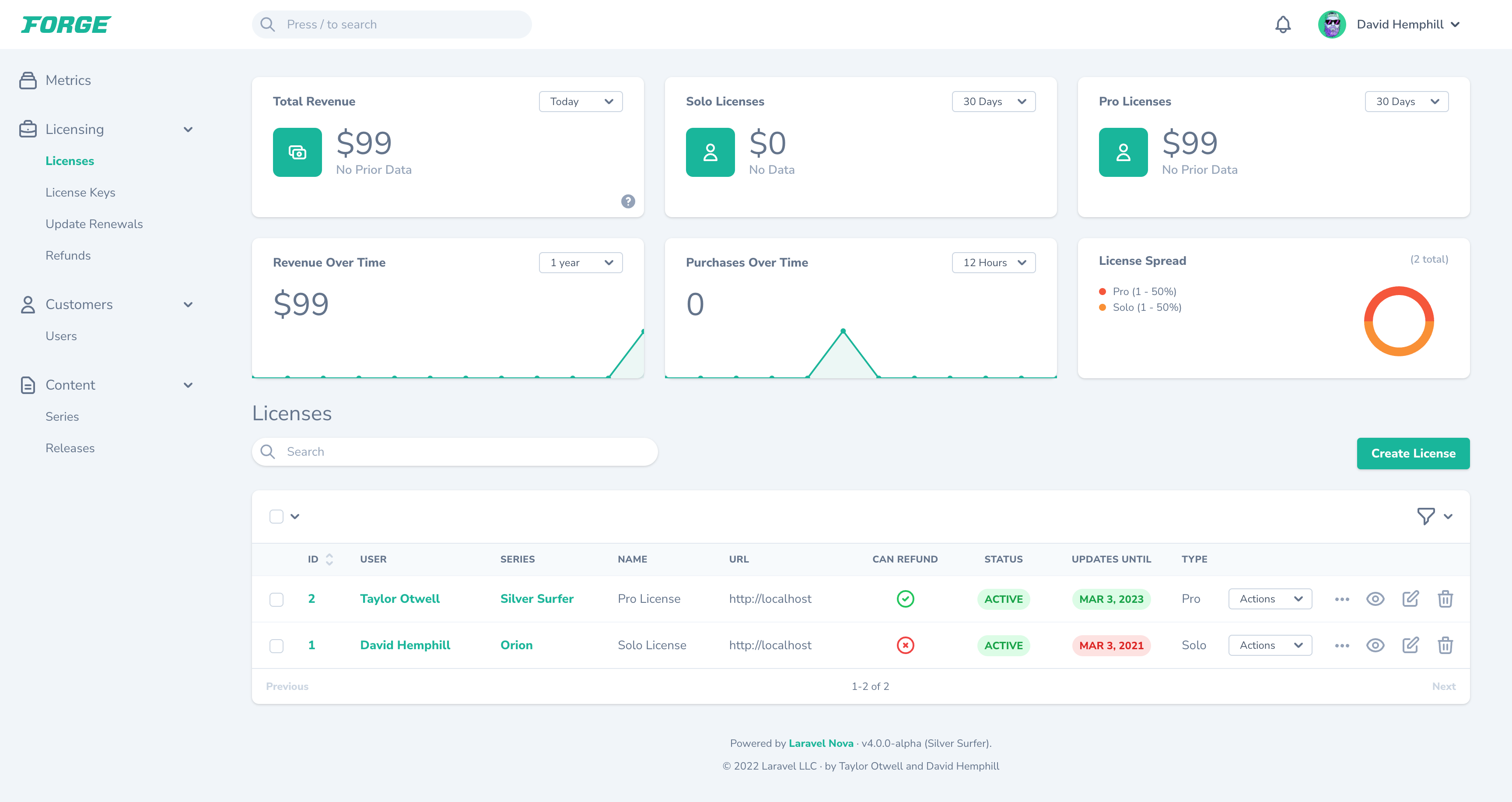
Although Nova's interface is intended to be an isolated part of your application that is managed by Nova, you can make some small customizations to the branding logo and color used by Nova to make the interface more cohesive with the rest of your application.
You can register a wildcard subdomain for your production URL for use in multi-tenant scenarios (e.g. `*.laravel.com`).
You can register your license key by setting the `NOVA_LICENSE_KEY` variable to `.env` file or `license_key` option in your `config/nova.php` configuration file:
```ini .env theme={null}
NOVA_LICENSE_KEY=
```
```php config/nova.php theme={null}
'license_key' => env('NOVA_LICENSE_KEY', ''),
```
### Verifying Your Nova License Key Configuration
To verify everything has been configured correctly, you should run the `nova:check-license` command:
```shell theme={null}
php artisan nova:check-license
```
## Authenticating Nova in CI Environments
It's not recommended to store your Composer `auth.json` file inside your project's source control repository. However, there may be times you wish to download Nova inside a CI environment like [GitHub Actions](https://github.com/features/actions). For instance, you may wish to run tests for any custom tools you create.
To authenticate Nova in these situations, you can use Composer's `config` command to set the configuration option inside your CI system's pipeline, injecting environment variables containing your Nova username and license key:
```shell GitHub Actions theme={null}
composer config http-basic.nova.laravel.com "${secrets.NOVA_USERNAME}" "${secrets.NOVA_LICENSE_KEY}"
```
## Using Nova on Development and Staging Domains
Since Nova can be used in local and staging development environments, Nova will not check your license key when used on `localhost` or local TLDs like those specified in [IETF RFC 2606](https://datatracker.ietf.org/doc/html/rfc2606#page-2):
* `.test`
* `.example`
* `.invalid`
* `.localhost`
* `.local`
Nova will also not check the current license key when the subdomain is one of these commonly-used staging subdomains:
* `staging.`
* `stage.`
* `test.`
* `testing.`
* `dev.`
* `development.`
## Authorizing Access to Nova
Within your `app/Providers/NovaServiceProvider.php` file, there is a `gate` method. This authorization gate controls access to Nova in **non-local** environments. By default, any user can access the Nova dashboard when the current application environment is `local`. You are free to modify this gate as needed to restrict access to your Nova installation:
```php app/Providers/NovaServiceProvider.php theme={null}
use Illuminate\Support\Facades\Gate;
// ...
/**
* Register the Nova gate.
*
* This gate determines who can access Nova in non-local environments.
*/
protected function gate(): void
{
Gate::define('viewNova', function ($user) {
return in_array($user->email, [
'taylor@laravel.com',
]);
});
}
```
## Customization
### Branding
Although Nova's interface is intended to be an isolated part of your application that is managed by Nova, you can make some small customizations to the branding logo and color used by Nova to make the interface more cohesive with the rest of your application.
 #### Brand Logo
To customize the logo used at the top left of the Nova interface, you may specify a configuration value for the `brand.logo` configuration item within your application's `config/nova.php` configuration file. This configuration value should contain an absolute path to the SVG file of the logo you would like to use:
```php config/nova.php theme={null}
'brand' => [
'logo' => resource_path('/img/example-logo.svg'),
// ...
],
```
You may need to adjust the size and width of your SVG logo by modifying its width in the SVG file itself.
#### Brand Color
To customize the color used as the "primary" color within the Nova interface, you may specify a value for the `brand.colors` configuration item within your application's `config/nova.php` configuration file. This color will be used as the primary button color as well as the color of various emphasized items throughout the Nova interface. This configuration value should be a valid RGB, RGBA, or HSL string value:
```php config/nova.php theme={null}
'brand' => [
// ...
'colors' => [
"400" => "24, 182, 155, 0.5",
"500" => "24, 182, 155",
"600" => "24, 182, 155, 0.75",
]
],
```
### Customizing Nova's Footer
There are times you may wish to customize Nova's default footer text to include relevant information for your users, such as your application version, IP addresses, or other information. Using the `Nova::footer` method, you may customize the footer text of your Nova installation. Typically, the `footer` method should be called within the `boot` method of your application's `App\Providers\NovaServiceProvider` class:
```php app/Providers/NovaServiceProvider.php theme={null}
use Illuminate\Http\Request;
use Illuminate\Support\Facades\Blade;
use Laravel\Nova\Nova;
// ...
/**
* Boot any application services.
*/
public function boot(): void
{
parent::boot();
Nova::footer(function (Request $request) {
return Blade::render('
@env(\'prod\')
This is production!
@endenv
');
});
}
```
### Customizing Nova's Authentication Guard
Nova uses the default authentication guard defined in your `auth` configuration file. If you would like to customize this guard, you may set the `NOVA_GUARD` value using `.env` file or `guard` value within Nova's configuration file:
```ini .env theme={null}
NOVA_GUARD=(null)
```
```php config/nova.php theme={null}
'guard' => env('NOVA_GUARD', null),
```
### Customizing Nova's Storage Disk Driver
Nova uses the default storage disk driver defined in your `filesystems` configuration file. If you would like to customize this disk, you may set the `NOVA_STORAGE_DISK` value using `.env` file the `storage_disk` value within Nova's configuration file:
```ini .env theme={null}
NOVA_STORAGE_DISK=public
```
```php config/nova.php theme={null}
'storage_disk' => env('NOVA_STORAGE_DISK', 'public'),
```
### Customizing Nova's Initial Path
When visiting Nova, the `Main` dashboard is typically loaded by default. However, you are free to define a different initial path that should be loaded using Nova's `initialPath` method. Typically, this method may be invoked from the `register` method of your application's `App\Providers\NovaServiceProvider` service provider:
```php app/Providers/NovaServiceProvider.php {8} theme={null}
/**
* Register any application services.
*/
public function register(): void
{
parent::register();
Nova::initialPath('/resources/users');
// ...
}
```
In addition to a string path, the `initialPath` method also accepts a closure that returns the path that should be loaded. This allows you to dynamically determine the initial path based on the incoming request:
```php app/Providers/NovaServiceProvider.php {8-10} theme={null}
/**
* Register any application services.
*/
public function register(): void
{
parent::register();
Nova::initialPath(function ($request) {
return $request->user()->initialPath();
});
// ...
}
```
### Enabling Breadcrumbs
If you would like Nova to display a "breadcrumb" menu as you navigate your Nova dashboard, you may invoke the `Nova::withBreadcrumbs` method. This method should be invoked from within the `boot` method of your application's `App\Providers\NovaServiceProvider` class:
```php app/Providers/NovaServiceProvider.php {8} theme={null}
/**
* Boot any application services.
*/
public function boot(): void
{
parent::boot();
Nova::withBreadcrumbs();
}
```
The `withBreadcrumbs` method also accepts a closure that allows you to enable breadcrumbs for specific users or other custom scenarios:
```php app/Providers/NovaServiceProvider.php {6-8} theme={null}
use Laravel\Nova\Http\Requests\NovaRequest;
use Laravel\Nova\Nova;
// ...
Nova::withBreadcrumbs(function (NovaRequest $request) {
return $request->user()->wantsBreadcrumbs();
});
```
### Enabling RTL Support
If you wish to display Nova's content "right-to-left" (RTL), you can enable this behavior by calling the `enableRTL` method from your `App\Providers\NovaServiceProvider` service provider:
```php app/Providers/NovaServiceProvider.php {8} theme={null}
/**
* Boot any application services.
*/
public function boot(): void
{
parent::boot();
Nova::enableRTL();
}
```
The `enableRTL` method also accept a closure that allows you to enable RTL support for specific users or in other custom scenarios:
```php theme={null}
use Illuminate\Http\Request;
use Laravel\Nova\Nova;
// ...
Nova::enableRTL(fn (Request $request) => $request->user()->wantsRTL());
```
### Disabling Nova's Theme Switcher
If you wish to completely hide Nova's light/dark mode switcher and instead have Nova honor the system preference only, you can call the `withoutThemeSwitcher` method from your `App/Providers/NovaServiceProvider`:
```php app/Providers/NovaServiceProvider.php {8} theme={null}
/**
* Boot any application services.
*/
public function boot(): void
{
parent::boot();
Nova::withoutThemeSwitcher();
}
```
## Error Reporting
Nova uses its own internal exception handler instead of using the default `App\Exceptions\ExceptionHandler`. If you need to integrate third-party error reporting tools with your Nova installation, you should use the `Nova::report` method. Typically, this method should be invoked from the `register` method of your application's `App\Providers\NovaServiceProvider` class:
```php app/Providers/NovaServiceProvider.php {8-12} theme={null}
/**
* Register any application services.
*/
public function register(): void
{
parent::register();
Nova::report(function ($exception) {
if (app()->bound('sentry')) {
app('sentry')->captureException($exception);
}
});
}
```
## Updating Nova
To update your Nova installation, you may run the `composer update` command:
```shell theme={null}
composer update
```
### Updating Nova's Assets
After updating to a new Nova release, you should be sure to update Nova's JavaScript and CSS assets using the `nova:publish` Artisan command and clear any cached views using the `view:clear` Artisan command. This will ensure the newly-updated Nova version is using the latest versions of Nova's assets and views:
```shell theme={null}
php artisan nova:publish
php artisan view:clear
```
The `nova:publish` command will re-publish Nova's public assets, configuration, views, and language files. This command will not overwrite any existing configuration, views, or language files. If you would like the command to overwrite existing files, you may use the `--force` flag when executing the command:
```shell theme={null}
php artisan nova:publish --force
```
### Keeping Nova's Assets Updated
To ensure Nova's assets are updated when a new version is downloaded, you may add a Composer hook inside your project's `composer.json` file to automatically publish Nova's latest assets:
```json composer.json {4} theme={null}
"scripts": {
"post-update-cmd": [
"@php artisan vendor:publish --tag=laravel-assets --ansi --force",
"@php artisan nova:publish --ansi"
]
}
```
## Code Distribution
Nova's license does not allow the public distribution of its source code. So, you may not build an application using Nova and distribute that application public via open source repository hosting platforms or any other code distribution platform.
If you would like to develop a third party package that augments Nova's functionality, you are free to do so. However, you may not distribute the Nova source code along with your package.
## Legal and Compliance
Our [Terms of Service](https://nova.laravel.com/terms) and [Privacy Policy](https://nova.laravel.com/privacy) provide details on the terms, conditions, and privacy practices for using Laravel Nova.
#### Brand Logo
To customize the logo used at the top left of the Nova interface, you may specify a configuration value for the `brand.logo` configuration item within your application's `config/nova.php` configuration file. This configuration value should contain an absolute path to the SVG file of the logo you would like to use:
```php config/nova.php theme={null}
'brand' => [
'logo' => resource_path('/img/example-logo.svg'),
// ...
],
```
You may need to adjust the size and width of your SVG logo by modifying its width in the SVG file itself.
#### Brand Color
To customize the color used as the "primary" color within the Nova interface, you may specify a value for the `brand.colors` configuration item within your application's `config/nova.php` configuration file. This color will be used as the primary button color as well as the color of various emphasized items throughout the Nova interface. This configuration value should be a valid RGB, RGBA, or HSL string value:
```php config/nova.php theme={null}
'brand' => [
// ...
'colors' => [
"400" => "24, 182, 155, 0.5",
"500" => "24, 182, 155",
"600" => "24, 182, 155, 0.75",
]
],
```
### Customizing Nova's Footer
There are times you may wish to customize Nova's default footer text to include relevant information for your users, such as your application version, IP addresses, or other information. Using the `Nova::footer` method, you may customize the footer text of your Nova installation. Typically, the `footer` method should be called within the `boot` method of your application's `App\Providers\NovaServiceProvider` class:
```php app/Providers/NovaServiceProvider.php theme={null}
use Illuminate\Http\Request;
use Illuminate\Support\Facades\Blade;
use Laravel\Nova\Nova;
// ...
/**
* Boot any application services.
*/
public function boot(): void
{
parent::boot();
Nova::footer(function (Request $request) {
return Blade::render('
@env(\'prod\')
This is production!
@endenv
');
});
}
```
### Customizing Nova's Authentication Guard
Nova uses the default authentication guard defined in your `auth` configuration file. If you would like to customize this guard, you may set the `NOVA_GUARD` value using `.env` file or `guard` value within Nova's configuration file:
```ini .env theme={null}
NOVA_GUARD=(null)
```
```php config/nova.php theme={null}
'guard' => env('NOVA_GUARD', null),
```
### Customizing Nova's Storage Disk Driver
Nova uses the default storage disk driver defined in your `filesystems` configuration file. If you would like to customize this disk, you may set the `NOVA_STORAGE_DISK` value using `.env` file the `storage_disk` value within Nova's configuration file:
```ini .env theme={null}
NOVA_STORAGE_DISK=public
```
```php config/nova.php theme={null}
'storage_disk' => env('NOVA_STORAGE_DISK', 'public'),
```
### Customizing Nova's Initial Path
When visiting Nova, the `Main` dashboard is typically loaded by default. However, you are free to define a different initial path that should be loaded using Nova's `initialPath` method. Typically, this method may be invoked from the `register` method of your application's `App\Providers\NovaServiceProvider` service provider:
```php app/Providers/NovaServiceProvider.php {8} theme={null}
/**
* Register any application services.
*/
public function register(): void
{
parent::register();
Nova::initialPath('/resources/users');
// ...
}
```
In addition to a string path, the `initialPath` method also accepts a closure that returns the path that should be loaded. This allows you to dynamically determine the initial path based on the incoming request:
```php app/Providers/NovaServiceProvider.php {8-10} theme={null}
/**
* Register any application services.
*/
public function register(): void
{
parent::register();
Nova::initialPath(function ($request) {
return $request->user()->initialPath();
});
// ...
}
```
### Enabling Breadcrumbs
If you would like Nova to display a "breadcrumb" menu as you navigate your Nova dashboard, you may invoke the `Nova::withBreadcrumbs` method. This method should be invoked from within the `boot` method of your application's `App\Providers\NovaServiceProvider` class:
```php app/Providers/NovaServiceProvider.php {8} theme={null}
/**
* Boot any application services.
*/
public function boot(): void
{
parent::boot();
Nova::withBreadcrumbs();
}
```
The `withBreadcrumbs` method also accepts a closure that allows you to enable breadcrumbs for specific users or other custom scenarios:
```php app/Providers/NovaServiceProvider.php {6-8} theme={null}
use Laravel\Nova\Http\Requests\NovaRequest;
use Laravel\Nova\Nova;
// ...
Nova::withBreadcrumbs(function (NovaRequest $request) {
return $request->user()->wantsBreadcrumbs();
});
```
### Enabling RTL Support
If you wish to display Nova's content "right-to-left" (RTL), you can enable this behavior by calling the `enableRTL` method from your `App\Providers\NovaServiceProvider` service provider:
```php app/Providers/NovaServiceProvider.php {8} theme={null}
/**
* Boot any application services.
*/
public function boot(): void
{
parent::boot();
Nova::enableRTL();
}
```
The `enableRTL` method also accept a closure that allows you to enable RTL support for specific users or in other custom scenarios:
```php theme={null}
use Illuminate\Http\Request;
use Laravel\Nova\Nova;
// ...
Nova::enableRTL(fn (Request $request) => $request->user()->wantsRTL());
```
### Disabling Nova's Theme Switcher
If you wish to completely hide Nova's light/dark mode switcher and instead have Nova honor the system preference only, you can call the `withoutThemeSwitcher` method from your `App/Providers/NovaServiceProvider`:
```php app/Providers/NovaServiceProvider.php {8} theme={null}
/**
* Boot any application services.
*/
public function boot(): void
{
parent::boot();
Nova::withoutThemeSwitcher();
}
```
## Error Reporting
Nova uses its own internal exception handler instead of using the default `App\Exceptions\ExceptionHandler`. If you need to integrate third-party error reporting tools with your Nova installation, you should use the `Nova::report` method. Typically, this method should be invoked from the `register` method of your application's `App\Providers\NovaServiceProvider` class:
```php app/Providers/NovaServiceProvider.php {8-12} theme={null}
/**
* Register any application services.
*/
public function register(): void
{
parent::register();
Nova::report(function ($exception) {
if (app()->bound('sentry')) {
app('sentry')->captureException($exception);
}
});
}
```
## Updating Nova
To update your Nova installation, you may run the `composer update` command:
```shell theme={null}
composer update
```
### Updating Nova's Assets
After updating to a new Nova release, you should be sure to update Nova's JavaScript and CSS assets using the `nova:publish` Artisan command and clear any cached views using the `view:clear` Artisan command. This will ensure the newly-updated Nova version is using the latest versions of Nova's assets and views:
```shell theme={null}
php artisan nova:publish
php artisan view:clear
```
The `nova:publish` command will re-publish Nova's public assets, configuration, views, and language files. This command will not overwrite any existing configuration, views, or language files. If you would like the command to overwrite existing files, you may use the `--force` flag when executing the command:
```shell theme={null}
php artisan nova:publish --force
```
### Keeping Nova's Assets Updated
To ensure Nova's assets are updated when a new version is downloaded, you may add a Composer hook inside your project's `composer.json` file to automatically publish Nova's latest assets:
```json composer.json {4} theme={null}
"scripts": {
"post-update-cmd": [
"@php artisan vendor:publish --tag=laravel-assets --ansi --force",
"@php artisan nova:publish --ansi"
]
}
```
## Code Distribution
Nova's license does not allow the public distribution of its source code. So, you may not build an application using Nova and distribute that application public via open source repository hosting platforms or any other code distribution platform.
If you would like to develop a third party package that augments Nova's functionality, you are free to do so. However, you may not distribute the Nova source code along with your package.
## Legal and Compliance
Our [Terms of Service](https://nova.laravel.com/terms) and [Privacy Policy](https://nova.laravel.com/privacy) provide details on the terms, conditions, and privacy practices for using Laravel Nova.