> ## Documentation Index
> Fetch the complete documentation index at: https://nova.laravel.com/docs/llms.txt
> Use this file to discover all available pages before exploring further.
# Dashboards
> Nova dashboards provide a convenient way to build information overview pages that contain a variety of metrics and cards.
## Overview
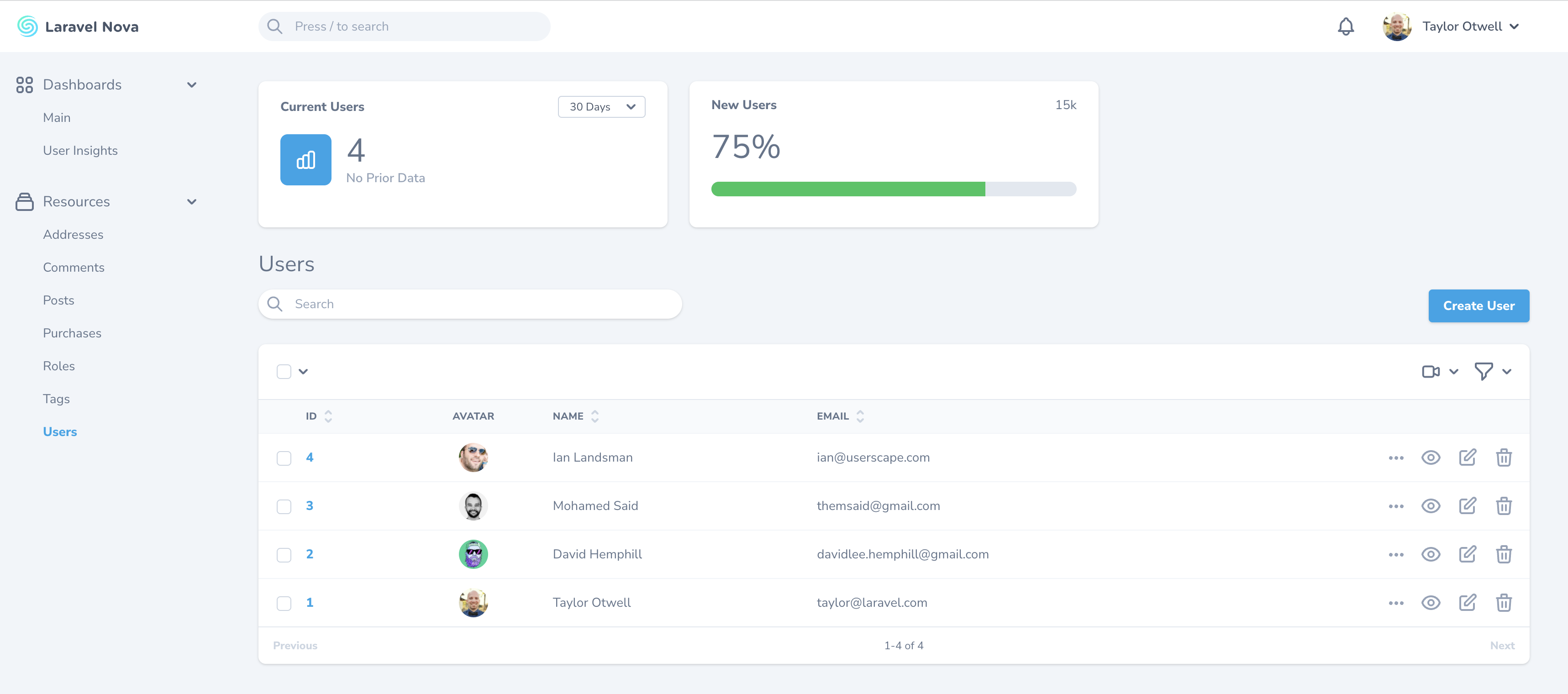
Nova dashboards provide a convenient way to build information overview pages that contain a variety of [metrics](./../metrics/defining-metrics) and [cards](../customization/cards).
 ### Default Dashboard
Nova ships with a default `App\Nova\Dashboards\Main` dashboard class containing a `cards` method. You can customize which cards are present on the default dashboard via this method:
```php app/Nova/Dashboards/Main.php {13-18} theme={null}
namespace App\Nova\Dashboards;
use Laravel\Nova\Cards\Help;
use Laravel\Nova\Dashboards\Main as Dashboard;
class Main extends Dashboard
{
/**
* Get the cards that should be displayed on the Nova dashboard.
*
* @return array
*/
public function cards(): array
{
return [
new Help,
];
}
}
```
More information regarding dashboard metrics can be found [within our documentation on metrics](../metrics/registering-metrics#dashboard-metrics).
## Defining Dashboards
Custom dashboards may be generated using the `nova:dashboard` Artisan command. By default, all new dashboards will be placed in the `app/Nova/Dashboards` directory:
```shell theme={null}
php artisan nova:dashboard UserInsights
```
Once your dashboard class has been generated, you're ready to customize it. Each dashboard class contains a `cards` method. This method should return an array of card or metric classes:
```php app/Nova/Dashboards/UserInsights.php theme={null}
namespace App\Nova\Dashboards;
use Laravel\Nova\Dashboard;
use App\Nova\Metrics\TotalUsers;
use App\Nova\Metrics\UsersOverTime;
class UserInsights extends Dashboard
{
/**
* Get the cards for the dashboard.
*
* @return array
*/
public function cards(): array
{
return [
TotalUsers::make(),
UsersOverTime::make(),
];
}
}
```
#### Dashboard Names
By default, Nova will use the dashboard's class name to determine the displayable name of your dashboard that should be placed in the left-side navigation bar. You may customize the name of the dashboard displayed in the left-side navigation bar by overriding the `name` method within your dashboard class:
```php app/Nova/Dashboards/UserInsights.php theme={null}
/**
* Get the displayable name of the dashboard.
*
* @return \Stringable|string
*/
public function name()
{
return 'User Insights';
}
```
#### Dashboard URI Keys
If you need to change the URI of the dashboard, you may override the dashboard class' `uriKey` method. Of course, the URI represents the browser location that Nova will navigate to in when you click on the dashboard link in the left-side navigation bar:
```php app/Nova/Dashboards/UserInsights.php theme={null}
/**
* Get the URI key of the dashboard.
*
* @return string
*/
public function uriKey()
{
return 'user-insights-improved';
}
```
## Registering Dashboards
To register a dashboard, add the dashboard to the array returned by the `dashboards` method of your application's `App/Providers/NovaServiceProvider` class. Once you have added the dashboard to this method, it will become available for navigation in Nova's left-side navigation bar:
```php app/Providers/NovaServiceProvider.php theme={null}
use App\Nova\Dashboards\Main;
use App\Nova\Dashboards\UserInsights;
// ...
/**
* Get the dashboards that should be listed in the Nova sidebar.
*
* @return array
*/
protected function dashboards(): array
{
return [
Main::make(),
UserInsights::make(),
];
}
```
#### Customizing Dashboard Menus
You can customize the dashboard's menu by defining a `menu` method on your dashboard class:
```php app/Nova/Dashboards/UserInsights.php theme={null}
use Illuminate\Http\Request;
// ...
/**
* Get the menu that should represent the dashboard.
*
* @return \Laravel\Nova\Menu\MenuItem
*/
public function menu(Request $request)
{
return parent::menu($request)->withBadge(function () {
return 'NEW!';
});
}
```
Please refer to the documentation on [menu customization](./menus) for more information.
### Refreshing Dashboard Metrics
Occasionally, you may wish to refresh all the metrics' values inside your dashboard. You may do this by enabling the refresh button by using the `showRefreshButton` method on the dashboard instance:
```php app/Providers/NovaServiceProvider.php {15} theme={null}
use App\Nova\Dashboards\Main;
use App\Nova\Dashboards\UserInsights;
// ...
/**
* Get the dashboards that should be listed in the Nova sidebar.
*
* @return array
*/
protected function dashboards(): array
{
return [
Main::make(),
UserInsights::make()->showRefreshButton(),
];
}
```
### Authorization
If you would like to only expose a given dashboard to certain users, you may invoke the `canSee` method when registering your dashboard. The `canSee` method accepts a closure which should return `true` or `false`. The closure will receive the incoming HTTP request:
```php app/Providers/NovaServiceProvider.php {16-18} theme={null}
use App\Models\User;
use App\Nova\Dashboards\Main;
use App\Nova\Dashboards\UserInsights;
// ...
/**
* Get the dashboards that should be listed in the Nova sidebar.
*
* @return array
*/
protected function dashboards(): array
{
return [
Main::make(),
UserInsights::make()->canSee(function ($request) {
return $request->user()->can('viewUserInsights', User::class);
}),
];
}
```
In the example above, we are using Laravel's `Authorizable` trait's can method on our `User` model to determine if the authorized user is authorized for the `viewUserInsights` action. However, since proxying to authorization policy methods is a common use-case for `canSee`, you may use the `canSeeWhen` method to achieve the same behavior. The `canSeeWhen` method has the same method signature as the `Illuminate\Foundation\Auth\Access\Authorizable` trait's `can` method:
```php app/Providers/NovaServiceProvider.php {16} theme={null}
use App\Models\User;
use App\Nova\Dashboards\Main;
use App\Nova\Dashboards\UserInsights;
// ...
/**
* Get the dashboards that should be listed in the Nova sidebar.
*
* @return array
*/
protected function dashboards(): array
{
return [
Main::make(),
UserInsights::make()->canSeeWhen('viewUserInsights', User::class),
];
}
```
### Default Dashboard
Nova ships with a default `App\Nova\Dashboards\Main` dashboard class containing a `cards` method. You can customize which cards are present on the default dashboard via this method:
```php app/Nova/Dashboards/Main.php {13-18} theme={null}
namespace App\Nova\Dashboards;
use Laravel\Nova\Cards\Help;
use Laravel\Nova\Dashboards\Main as Dashboard;
class Main extends Dashboard
{
/**
* Get the cards that should be displayed on the Nova dashboard.
*
* @return array
*/
public function cards(): array
{
return [
new Help,
];
}
}
```
More information regarding dashboard metrics can be found [within our documentation on metrics](../metrics/registering-metrics#dashboard-metrics).
## Defining Dashboards
Custom dashboards may be generated using the `nova:dashboard` Artisan command. By default, all new dashboards will be placed in the `app/Nova/Dashboards` directory:
```shell theme={null}
php artisan nova:dashboard UserInsights
```
Once your dashboard class has been generated, you're ready to customize it. Each dashboard class contains a `cards` method. This method should return an array of card or metric classes:
```php app/Nova/Dashboards/UserInsights.php theme={null}
namespace App\Nova\Dashboards;
use Laravel\Nova\Dashboard;
use App\Nova\Metrics\TotalUsers;
use App\Nova\Metrics\UsersOverTime;
class UserInsights extends Dashboard
{
/**
* Get the cards for the dashboard.
*
* @return array
*/
public function cards(): array
{
return [
TotalUsers::make(),
UsersOverTime::make(),
];
}
}
```
#### Dashboard Names
By default, Nova will use the dashboard's class name to determine the displayable name of your dashboard that should be placed in the left-side navigation bar. You may customize the name of the dashboard displayed in the left-side navigation bar by overriding the `name` method within your dashboard class:
```php app/Nova/Dashboards/UserInsights.php theme={null}
/**
* Get the displayable name of the dashboard.
*
* @return \Stringable|string
*/
public function name()
{
return 'User Insights';
}
```
#### Dashboard URI Keys
If you need to change the URI of the dashboard, you may override the dashboard class' `uriKey` method. Of course, the URI represents the browser location that Nova will navigate to in when you click on the dashboard link in the left-side navigation bar:
```php app/Nova/Dashboards/UserInsights.php theme={null}
/**
* Get the URI key of the dashboard.
*
* @return string
*/
public function uriKey()
{
return 'user-insights-improved';
}
```
## Registering Dashboards
To register a dashboard, add the dashboard to the array returned by the `dashboards` method of your application's `App/Providers/NovaServiceProvider` class. Once you have added the dashboard to this method, it will become available for navigation in Nova's left-side navigation bar:
```php app/Providers/NovaServiceProvider.php theme={null}
use App\Nova\Dashboards\Main;
use App\Nova\Dashboards\UserInsights;
// ...
/**
* Get the dashboards that should be listed in the Nova sidebar.
*
* @return array
*/
protected function dashboards(): array
{
return [
Main::make(),
UserInsights::make(),
];
}
```
#### Customizing Dashboard Menus
You can customize the dashboard's menu by defining a `menu` method on your dashboard class:
```php app/Nova/Dashboards/UserInsights.php theme={null}
use Illuminate\Http\Request;
// ...
/**
* Get the menu that should represent the dashboard.
*
* @return \Laravel\Nova\Menu\MenuItem
*/
public function menu(Request $request)
{
return parent::menu($request)->withBadge(function () {
return 'NEW!';
});
}
```
Please refer to the documentation on [menu customization](./menus) for more information.
### Refreshing Dashboard Metrics
Occasionally, you may wish to refresh all the metrics' values inside your dashboard. You may do this by enabling the refresh button by using the `showRefreshButton` method on the dashboard instance:
```php app/Providers/NovaServiceProvider.php {15} theme={null}
use App\Nova\Dashboards\Main;
use App\Nova\Dashboards\UserInsights;
// ...
/**
* Get the dashboards that should be listed in the Nova sidebar.
*
* @return array
*/
protected function dashboards(): array
{
return [
Main::make(),
UserInsights::make()->showRefreshButton(),
];
}
```
### Authorization
If you would like to only expose a given dashboard to certain users, you may invoke the `canSee` method when registering your dashboard. The `canSee` method accepts a closure which should return `true` or `false`. The closure will receive the incoming HTTP request:
```php app/Providers/NovaServiceProvider.php {16-18} theme={null}
use App\Models\User;
use App\Nova\Dashboards\Main;
use App\Nova\Dashboards\UserInsights;
// ...
/**
* Get the dashboards that should be listed in the Nova sidebar.
*
* @return array
*/
protected function dashboards(): array
{
return [
Main::make(),
UserInsights::make()->canSee(function ($request) {
return $request->user()->can('viewUserInsights', User::class);
}),
];
}
```
In the example above, we are using Laravel's `Authorizable` trait's can method on our `User` model to determine if the authorized user is authorized for the `viewUserInsights` action. However, since proxying to authorization policy methods is a common use-case for `canSee`, you may use the `canSeeWhen` method to achieve the same behavior. The `canSeeWhen` method has the same method signature as the `Illuminate\Foundation\Auth\Access\Authorizable` trait's `can` method:
```php app/Providers/NovaServiceProvider.php {16} theme={null}
use App\Models\User;
use App\Nova\Dashboards\Main;
use App\Nova\Dashboards\UserInsights;
// ...
/**
* Get the dashboards that should be listed in the Nova sidebar.
*
* @return array
*/
protected function dashboards(): array
{
return [
Main::make(),
UserInsights::make()->canSeeWhen('viewUserInsights', User::class),
];
}
```